What is Becker Muscular Dystrophy?
BMD is a genetic condition caused by a defect in the dystrophin gene located on the X chromosome.
Becker Muscular Dystrophy (BMD) is named after German doctor Peter Emil Becker, who first distinguished the symptoms from other muscular dystrophies in the mid 1950s. BMD is considered to be a milder form of Duchenne Muscular Dystrophy (DMD), as both are caused by mutations in the same gene, and thus has similar symptoms. BMD occurs once in approximately 30,000 live male births. After a life-changing fall left him unable to walk, Allan had a choice: retreat from the world or find a new way forward. He chose to keep moving.
What are the features of Becker Muscular Dystrophy?
BMD is very variable in severity, depending on the type of mutation in the dystrophin gene. It is less severe than DMD and usually has a much later onset. Some people with BMD are able to walk well into adulthood. BMD, therefore, may not be diagnosed until after adolescence.
The following features may be displayed:
Muscle weakness
Muscle cramps
Fatigue
Breathing distress
Skeletal deformities
Unusual walking gait; waddling
Difficulties in hopping, running, jumping
Breathing and cardiac abnormalities as issues that arise later on in life, and breathing difficulties as one of the rarer complications of BMD
Muscle deformities – pseudo hypertrophy of calf; contractures. (Contractures are muscles or tendons that have remained too tight for too long, thus becoming shorter. Once they occur, they cannot be stretched or exercised away.)
Some children with BMD will experience further complications:
A minority of BMD children will display intellectual problems or learning difficulties.
Behavioural difficulties will on occasion arise with BMD, affecting the boy’s social interactions at home, at school and in other areas of his life. Such problems are usually mild and can be appropriately managed.
Rarely, heart disease such as cardiomyopathy will occur as the disease progresses.
Contractures occur as scar tissue replaces normal elastic tissue. This prevents normal movement in that area, first in the ankles, then knees, hips and joints of the upper body.
What causes Becker Muscular Dystrophy?
BMD is a genetic condition caused by a defect in the dystrophin gene located on the X chromosome. The faulty gene results in a deficiency of the protein dystrophin, causing muscles to deteriorate and break down in males.
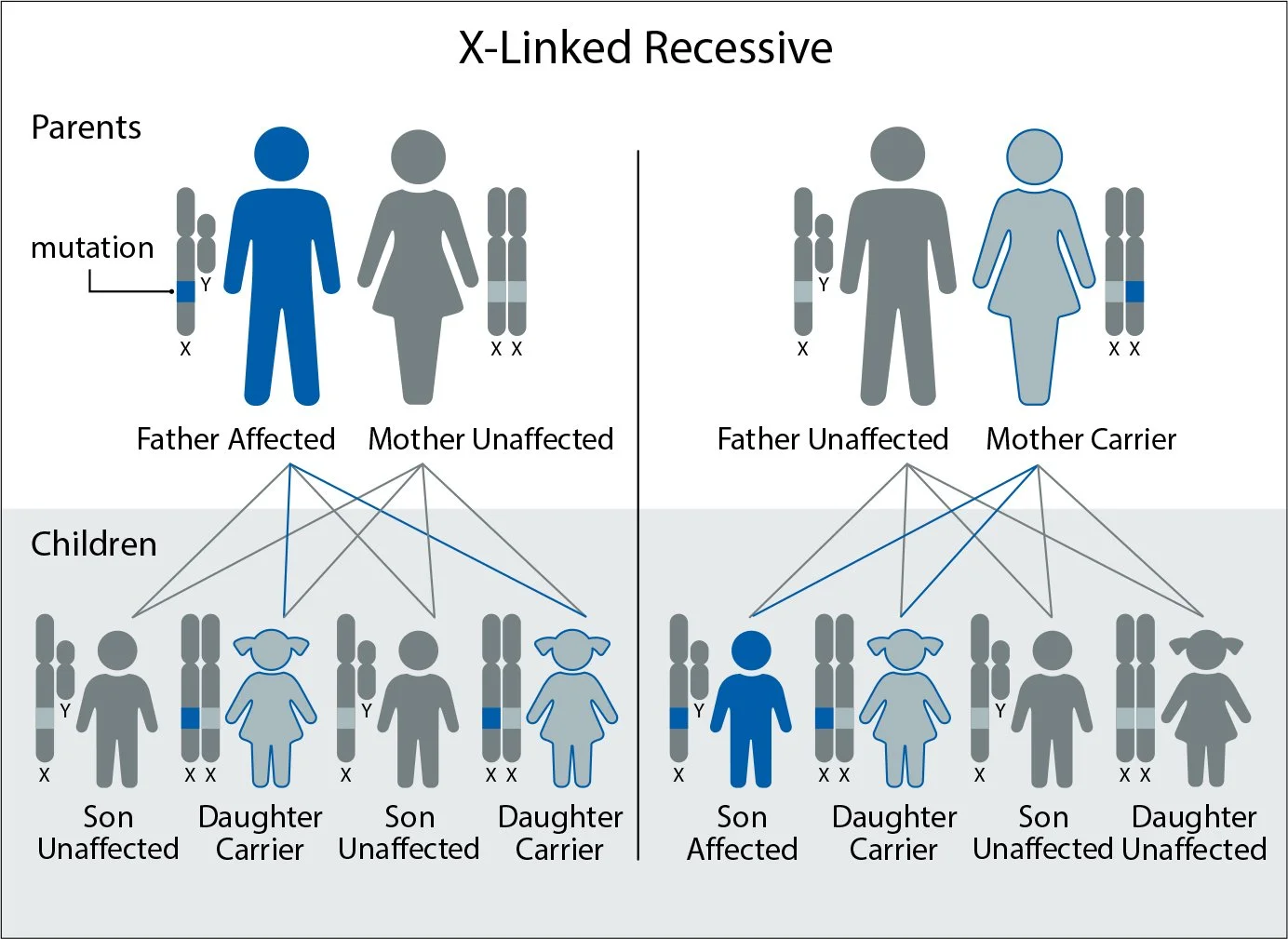
The dystrophin gene is located on the X chromosome. Females have two copies of the X chromosome. A woman who has one correct dystrophin gene and one faulty dystrophin gene can nearly always produce enough dystrophin to have normal muscle function.
She is therefore a “carrier” of the mutation or a “genetic carrier” of DMD or BMD. Males have only one X chromosome and therefore one dystrophin gene copy. So if a male has a faulty dystrophin gene, he will be affected with DMD or BMD since he cannot produce the correct amount or type of dystrophin protein. A small number of BMD female carriers (10%) may have issues with cardiomyopathy; therefore, it is important for carrier mothers to have engagement with cardiology and intermittent screening echocardiograms.
The pattern of inheritance of BMD is called X-linked recessive (see accompanying genetics fact sheet). If a woman is a carrier of the mutation (she has one copy of the faulty dystrophin gene), and she has a daughter, there is one chance in two that the daughter will be a carrier of the mutation and one chance in two that she will not, i.e. a 50% probability of being a genetic carrier of DMD or BMD and an equal chance of not being a carrier.
For each son of a genetic carrier, there is one chance in 2, i.e. a 50% probability, of being affected and an equal chance of not being affected. Since women have two X chromosomes, if one X chromosome has the defective gene, the other X chromosome functions to produce enough dystrophin for normal muscle function. Males, on the other hand, have one X and one Y chromosome; thus, they do not have a compensatory X chromosome and will develop symptoms.
Spontaneous mutations are responsible for approximately one-third of BMD cases, with the genetic fault arising in the affected boy himself. This happens when the mutation in the dystrophin gene occurs by chance in the formation of the egg or sperm. With a spontaneous mutation, the affected boy will be the first in his family to have BMD.
Both BMD and DMD are caused by mutations in the dystrophin gene
DMD is caused by an “out of frame” mutation in the dystrophin gene, which disrupts the reading frame, resulting in a truncated protein lacking function.
BMD is caused by an “in-frame” mutation in the dystrophin gene, which does not disrupt the reading frame and therefore results in a shorter, but still partially functional protein, which is why the clinical manifestations are often less severe than DMD.
Mode of inheritance
Diagnosis of Becker Muscular Dystrophy
Once BMD is suspected, diagnostic tests will be offered to establish a definite diagnosis. These may include:
CPK (CK) Testing: A positive blood test for BMD will demonstrate higher than normal levels of the muscle protein creatine phosphokinase. This enzyme leaks out of damaged muscles and into the blood serum. This is not, however, a conclusive test, as an elevated amount of CPK is also a feature of other muscular dystrophies. This could also be a marker of inflammation in muscles due to other reasons, not just muscular dystrophies
DNA Studies: In some cases, DNA studies are able to give definitive information about the genetic abnormality responsible for the faulty BMD gene, whilst in others the abnormality is not able to be exactly defined.
Muscle Biopsy: If the fault in the BMD gene is too small to be detected by DNA analysis, then a muscle biopsy may be the best option. Whilst under local anaesthetic, a small piece of muscle is taken from the thigh. Using special staining techniques in the laboratory, the muscle tissue is examined microscopically for the muscle protein dystrophin. The test is positive for BMD if there is an abnormally low level of dystrophin present.
Electromyography: An EMG gives information on the electrical activity of the muscle tested. It tells whether the muscle weakness is caused by damage to the muscles, as in BMD, or damage to the nerves in other conditions.
Genetic Counselling: Soon after the diagnosis of a BMD boy, it is essential that genetic counselling is arranged. Genetic testing and counselling in BMD families usually focus on one or both of two issues. The first is the probability that a particular female member of the family is a carrier of the mutation, and the second is whether testing for the condition in pregnancy can be offered and with what degree of reliability.
The probability of being a BMD carrier is first assessed by examining the family tree. She may be an obligate genetic carrier, a possible genetic carrier, or a probable genetic carrier. Each son of a carrier female has a 1 in 2 (50%) chance of inheriting BMD through his mother’s faulty X chromosome, and similarly, each daughter has a 1 in 2 (50%) chance of being a carrier of BMD in the same way. An affected male will not pass on the gene to any of his sons, but his daughters will all be carriers.
Sometimes a woman or man has mutations in the BMD gene of his or her sperm or eggs, but not in the other cells of his or her body. The mutation may even be in some sperm and/or eggs but not in others. This situation is called germline mosaicism. Germline cells are the egg and sperm cells. Genetic tests can estimate the risk that a person has germline mosaicism, and provide information regarding the risk for a person with germline mosaicism to have a child with Becker muscular dystrophy.
Genetic counselling can provide diagnostic information without invasive muscle biopsies. These may include DNA analysis and Linkage Testing. If a woman knows she is a carrier, prenatal and pre-implantation diagnoses are also possible.
Clinical genetic services in NZ are available, and your doctor or the MDANZ can refer you.
Management of Becker Muscular Dystrophy
As yet, there is no treatment that can overcome the progressive muscle weakness of BMD. It is possible, however, to minimise complications by adhering to a management programme specially designed by a team of medical professionals. The team will usually be headed by a paediatric specialist, and include a physiotherapist, occupational therapist, together with specialists in other areas as required.
Exercise: Both passive and active exercises play an important role in BMD management. Walking is easily achieved in the early stages, but can become more difficult as strength declines. Walking sticks and aids can be valuable in prolonging mobility for as long as possible. Swimming is good for ensuring all muscles are exercised, and the joints mobilised.
Passive exercises, or assisted stretching, should be established as early as possible. A physiotherapist is invaluable in the development of an exercise programme to delay the shortening of muscles (contractures). These exercises should be undertaken on a daily basis, and will often require the assistance of parents and/or caregivers.
Moderate exercise rather than heavy strenuous exercise is important. People who have muscular dystrophy disorders are more likely to tire quickly and easily, and overdoing it may cause irreparable muscle damage.
Supportive Equipment: If and when contractures develop in the ankle joints, a type of orthotic may be offered to the BMD boy to be worn at night. These ankle splints will help maintain the joint in a normal position, and may help reduce the pain experienced from muscle cramping.
Standing frames may prolong standing and walking, although it is likely that a wheelchair will eventually be needed. An occupational therapist and/or seating therapist can advise on the most appropriate type of chair and supportive seating.
The suitability of the home environment is important to consider at an early stage, so that future adjustments can be made over time. Multi-storied housing can compromise accessibility, and the installation of a lift may bring further problems. When a powered wheelchair becomes necessary, a suitable vehicle for transportation, as well as access and adjacent parking space, will be required. Space for a ramp will be necessary up steps, as well as doorways wide enough to allow a wheelchair through.
Medical Treatment: Many medicines and dietary supplements have been tried over the years to treat the symptoms of BMD. So far, there is only one group of drugs – the catabolic steroids – that have shown any significant benefit.
While there is good evidence for use of steroids in DMD, there is minimal evidence for use in BMD. It is sometimes used in an “off label manner” in children with severe Becker’s. This needs to be discussed with the clinician involved, as steroids have lots of possible long-term side effects listed above, including issues with poor growth, delayed puberty, and weak bones.
Nutrition: Excessive weight gain leading to obesity can occur from reduced physical activity produced by the muscle weakness. It is more important for an individual with BMD than the average person that weight is monitored and that a well-balanced diet is followed.
Obesity can further complicate the difficulties a BMD boy will experience with his heart and bowel function, and also with breathing. Family and friends can assist the BMD boy to adhere to his diet by offering him healthy foods such as fruit and vegetables, and restricting foods containing high levels of sugar and fat.
Surgery: If contractures develop at the ankle joints, these can be surgically treated by release of the Achilles tendon. Having a comfortable foot position may help prolong mobility for some BMD boys. Spinal fusion surgery is performed to correct scoliosis. It is advisable that scoliosis is surgically corrected at the ideal time during a ‘window of opportunity’ which takes into account the boy’s stage of adolescent growth. Becker boys who undergo this ‘spinal fusion’ are usually very pleased with the outcome.
Respiration: The normal defences people use to rid themselves of excessive secretions do not function effectively in BMD boys, and the early treatment of sniffles and sore throats, and the prevention of chest infections are important. People with BMD should try to preserve their lung function by avoiding secondhand smoke, and in no circumstance should he be an active smoker.
Family and caregivers must watch carefully for signs of disrupted sleep due to respiratory problems. Signs include morning drowsiness, lack of concentration, headaches, confusion, sleepiness during the day and wakefulness at night with an increased need to be turned.
When respiratory problems become apparent, ventilation machines are available to assist with ventilation during the night.
Research into Becker Muscular Dystrophy
There are many promising results from ongoing research each year, but it is difficult to say whether that will translate into something we will see in the clinic in five years, 10 years, etc. Research is currently being conducted on how the form of dystrophin produced in
BMD (as opposed to DMD, where it is completely absent) leads to a milder disease. This may help in the development of treatments specifically for BMD. There is also research emerging about a new drug that may help boys with “premature stop codons”, and there is a gene therapy trial on the horizon as well.
Support for people with Becker Muscular Dystrophy
Support is available from the MDANZ who can offer specialist assessment, information, support, advocacy and referrals to other providers. There is also a nationwide Support Network for those interested in meeting with others.
Education:In New Zealand, every child has the right of equal access to all aspects of education. This means that all children with a neuromuscular condition have the right to attend a mainstream school. Many schools have special units attached which can provide any extra help needed, including an individualised education plan for appropriate assistance with physical and mental needs. It is important that BMD children are not overprotected or patronised – they should be mentally stimulated and creative skills encouraged.
Employment: Seeking and maintaining paid employment can be challenging for people with Becker, especially as their condition progresses. Despite these challenges, many people in New Zealand with neuromuscular conditions carve out a career and work productively and successfully for a number of years. Research has shown that a paid occupation is achievable for others with the correct supports and environmental conditions (flexibility, adaptations, employer recognition, peer support).
When choosing a career, if possible choose something that you are passionate about, and that meets your physical needs now and into the future as your condition progresses. Consider the workload; repetitive tasks, physicality of the job, or how much speaking is required if you struggle with slurred speech.
Ask about opportunities for job shadowing to get a sense of daily tasks and expectations. Consider: when are you more alert and more fatigued? Is there flexibility to work from home on certain days or to be flexible with work schedules so you can incorporate rests if needed? Will the job accommodate flexibility to meet these needs so you can be more productive in your role?
Volunteer work is an opportunity to build up skills and experience. It creates the same feelings of self-worth, sense of identity and purpose as a paid job.
The New Zealand government recognises the value people with a disability can bring to a workforce and the underrepresentation of this community in the labour market. They have set up a number of employment-related services and supports for people with a disability, including training and apprenticeships. The list of all government-funded or supported services is available on the website Employment New Zealand.
Diversity Works New Zealand (formerly the EEO Trust) is the national body for workplace diversity and inclusion. They can be contacted on 0800 348 377 or by visiting their website diversityworksnz.org.nz/
Remember, it is illegal for employers to discriminate against people because of ethnicity, sexual orientation, gender, marital status, religious belief, or disability. Equal rights are demanded by the Human Rights Act, 1993, and the Equal Pay Act, 1972. You can seek information about your rights on the Health and Disability Commissioner website or the Human Rights Commission website.
More Information
Muscular Dystrophy Association can be contacted for further information, assistance, advice, support and referrals on 0800 800 337 or by e-mail at info@mda.org.nz. The Muscular Dystrophy Association Website also contains information on services available within NZ, our quarterly magazine, contacts, membership details, news and links to other sites.
Further Resources
www.mdausa.org – the Muscular Dystrophy Association USA website has an extensive site with plenty of further information on any muscular dystrophy conditions as well as research news.
www.muscular-dystrophy.org – the UK muscular dystrophy site. It contains good general information on the condition.
NZ also has an excellent website dedicated to helping and informing those families with rare disorders www.nzord.org.nz